Chiropractic physician Dr. David Lipman explores why tissue responds to safety rather than brute force — detailing 10,000 VPM vibration mechanics, neurological gate control, and why percussion massage guns often miss the mark.

Chiropractic physician Dr. David Lipman explores why tissue responds to safety rather than brute force — detailing 10,000 VPM vibration mechanics, neurological gate control, and why percussion massage guns often miss the mark.

Founder, Physical Evidence Biohacking & Wellness Center • Boca Raton, FL
EXCELLENTTrustindex verifies that the original source of the review is Google. Life-changing experience with Dr. Lipman Dr. Lipman truly saved me today. I’ve been seeing a chiropractor on and off, but it turns out my issue was much deeper than just adjustments. What I was dealing with was significant fascial restriction and twisting that needed to be released, not just cracked and sent on my way. Dr. Lipman immediately recognized this and took the time to actually address the root of the problem. His knowledge of fascia and the body as a whole is incredible. The work he did was intentional, thorough, and exactly what my body needed. Even though I know I have a journey ahead of me, I already feel so much better after just one visit, which honestly says everything. I finally feel hopeful instead of frustrated. If you’ve been going to chiropractors and feel like something is still “off,” do yourself a favor and see Physical Evidence Chiropractic: David Lipman, DC. This is a whole different level of care, and I am beyond grateful I found him. Highly, highly recommend. I want to add I’ve seen him a few years ago and he was amazing but his visits had cost a little more than my regular chiropractor and now my body truly paid the price!!! not once did he make me feel bad for not coming back he picked up right where he left off!!Posted on GoogleTrustindex verifies that the original source of the review is Google. I was given an unlimited month of red light therapy for Christmas! Today I enjoyed my first session and am super happy with the vibe. Dr Lipman is wonderful, and his receptionist Sage certainly takes today's review to the top! I purchased methylene blue and got the list of prices so that when my unlimited month is over I can continue on. Definitely five stars for cleanliness, convenience and easy to find using Google maps. Boca Raton has a GEM in Physical Evidence.Posted on GoogleTrustindex verifies that the original source of the review is Google. I’ve only seen Dr. Lipman once so far, and I’m already blown away. I went to him for a piriformis issue, and unfortunately I had taken a fall right before my appointment and was in quite a bit of pain. Dr. Lipman addressed it immediately and the pain was gone by the time I left his office. What truly amazed me is something I didn’t even mention to him. Years ago, I was in a severe accident and have had limited ability to turn my neck. I had accepted that this was just how it would be. After just one visit with Dr. Lipman, I have full range of motion in my neck, something I haven’t had in years. This isn’t my first experience with chiropractors; I’ve seen many over the years. Dr. Lipman is different. He genuinely takes his time, listens, and truly cares. He is incredibly knowledgeable and clearly has a passion for helping his patients heal. He is so much more than a chiropractor. Highly recommended!Posted on GoogleTrustindex verifies that the original source of the review is Google. Dr Lipman eliminated severe pain i have had in my back shoulders and neck in just a month of working with him. His treatments were incredibly effective and fast. I have spent years in chiropractic offices, physical therapy, and recovering from surgeries, but nothing has come close to the relief and healing I got from Dr Lipman He’s the manPosted on GoogleTrustindex verifies that the original source of the review is Google. I found Physical Evidence online because I’m increasingly interested in combining physical exercise with technology that helps improve overall health. I felt very satisfied with the service. My specific goal was to try red light therapy, and the red light cabin they have is one of the highest-quality devices on the market. (I like to do my own research whenever I go to a place to see what machines they use.) Especially for me, since I’m looking for skin benefits, it’s much better than just a panel that doesn’t cover the whole body. I also tried electromagnetic therapy, which was very relaxing. Dr. Lipman is very professional. I usually ask a lot of questions about the therapies and how they work, and it’s clear that his knowledge is extensive. He also helped me better understand what to do about my lower back pain. Definitely a must-try for people who want to experience modern therapy for wellness and beauty. Dr. Lipman and his staff are exceptional.Posted on GoogleTrustindex verifies that the original source of the review is Google. Amazing doctor and great person. Everyone in the office is wonderful and I always leave feeling better. Highest recommendation.Posted on GoogleTrustindex verifies that the original source of the review is Google. A mix of science and holystic that is giving me results 💪🏽Posted on GoogleTrustindex verifies that the original source of the review is Google. I visited Dr Lipman's office today, received and adjustment and information on the services he offers including the Super Human Protocol. He is an incredible wealth of knowledge and is intentional to explain things in a way that is easy to comprehend. I found him to be very trustworthy and I FEEL GREAT!!!! Thank you Dr Lipman, I look forward to my next visit!Posted on GoogleTrustindex verifies that the original source of the review is Google. I recently had the pleasure of visiting Dr. Lipman for my husband's back pain, and I can't recommend him highly enough. From the moment we walked in, his professionalism and empathetic nature stood out. Dr. Lipman took the time to listen to my husband's concerns and thoroughly assessed his condition before proceeding with treatment. What impressed me most was his caring approach—he made sure my husband felt comfortable and informed every step of the way. The treatment plan he provided was tailored specifically to my husband's needs, and we both appreciated how he explained the process in a way that was easy to understand. Thanks to Dr. Lipman's expertise, my husband has experienced significant relief from his back pain. If you're looking for a chiropractor who combines professionalism with genuine care for his patients, Dr. Lipman is definitely the right choice!Posted on GoogleTrustindex verifies that the original source of the review is Google. Dr. David Lipman is the absolute best in the business. Other doctors will give you temporary relief but Dr David will treat the root of your problem and ensure your relief. I have referred 5 people to him and everyone including myself, has been relieved of the prolonged issues they have had. I suffered from injuries and dealt with chronic issues and pain from them. I never thought I would have complete relief. Dr. David cured me. He is full of knowledge and so kind. I can’t say enough good things about him. Thank you Dr. David.
You’ve been stretching it. Rolling it. Pressing on it with a lacrosse ball against the wall. It loosens for an hour, maybe an afternoon — and then it’s right back where it was.
Most people take that to mean one thing: the muscle is tight, so it needs more force. Deeper pressure. A harder tool.
I want to offer you a different explanation. After more than forty years with my hands on people’s bodies, here’s what I keep seeing: Tissue that’s already inflamed and guarded doesn’t respond to force. It responds to safety.
That’s why Rapid Release lives in my treatment rooms at Physical Evidence in Boca Raton, and it’s why I get asked about it almost every week.


Rapid Release is a high-speed, short-stroke vibration device registered with the FDA as a Class I medical device.
It was invented by a chiropractor, Dr. Stanley Stanbridge — which tells you something about the problem it was designed to solve. Two numbers explain the entire design:
Small design decisions. Large difference in how the session feels. Full specifications are available at Rapid Release.
This is the question I get most, so let’s settle the physical and physiological differences.
| Specification / Parameter | Rapid Release (High-Speed Vibration) | Percussion Massage Gun |
|---|---|---|
| Operating Speed | 4,000–10,000 VPM 3-5x Faster | 2,100–3,600 RPM |
| Stroke / Amplitude | 1/16” (Micro-travel orbit) | Up to 5/8” (Deep punch) |
| Tissue Motion | High-frequency orbital vibration | Long-stroke percussive hammering |
| Form Factor | Linear / ergonomic 5-surface wand | Pistol-grip / bulky triangle handle |
| Best Suited For | Full body, extremities, sensitive zones, spine | Large, non-sensitive muscle mass (e.g. glutes) |
| Device Weight | 1.2–2.3 lbs (Lightweight) | 2.5–3.1 lbs (Heavy & arm-fatiguing) |
Why It Works: Occupies fast touch nerve fibers, quieting protective pain signals so guarded, inflamed tissue can immediately relax.
The Problem on Guarded Tissue: When hammered, already-inflamed tissue braces defensively. You leave sore, bruised, and tense.
Read those first two table rows together, because this is where most reviews get it backwards. Rapid Release runs three to five times faster than a massage gun at roughly one-tenth the stroke depth. It is not a more intense massage gun. It’s the opposite trade: far more speed, far less force.
A long stroke at low speed pushes into muscle. A short stroke at high speed vibrates through it. On a healthy quad after leg day, pushing in feels fine. On an inflamed shoulder, a guarded neck, or the small muscles of a hand, pushing in is the problem.
On tissue that’s already irritated, even the lowest percussive settings can be genuinely uncomfortable. And a person who is bracing against the tool cannot release. You can’t relax someone into recovery while you’re hurting them.
Both tools have a place, and I own both. Percussion is a reasonable choice for large, healthy muscle mass. I reach for vibration when tissue is tender, guarded, or sitting close to bone.
Now let me make this practical, because the mechanism is genuinely simple.
Your nervous system carries different signals along different-sized nerve fibers, and they don’t all travel at the same speed. The large fibers carrying touch, pressure, and vibration are fast. The smaller fibers carrying pain are slower.
Gate control theory — one of the most well-established ideas in pain science — describes what happens when both arrive at the spinal cord at once. Activity in the large, fast fibers inhibits transmission of the slower pain signals before they ever reach the brain. Researchers describe it as closing the gate.
You already know this works. When you bang your elbow, what do you do? You rub it. Nobody taught you that. Your body worked it out on its own.
High-frequency vibration is that same reflex, delivered with mechanical precision. In the treatment room, that vibrational input quiets pain signaling while I work on underlying restrictions. A nervous system that feels safe stops guarding.
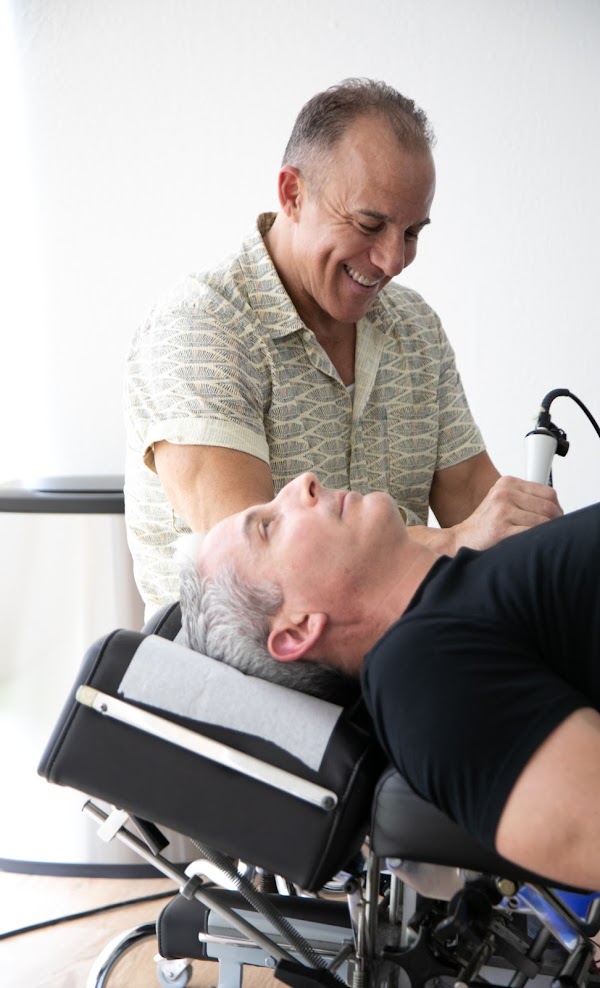
A word about expectations, because this is where wellness marketing usually goes off the rails. What follows is clinical observation from my own practice and consistent reports from other providers — not formal trial data. Individual results vary, and they should. You are not a spreadsheet.
The short stroke doesn’t pound or bruise the way harder-hitting tools can. Patients tell me it feels strange for about ten seconds, and then it just feels good.
Because the tissue isn’t taking a beating, people handle longer or more frequent sessions without paying for it the next day.
Many people report feeling looser and moving more freely before they get off the table. Not everyone, not always — but often enough that I keep the device within arm’s reach.
There are three distinct models. Don’t let anyone sell you the wrong instrument for your lifestyle.
The short stroke doesn’t pound or bruise the way harder-hitting tools can. Patients tell me it feels strange for about ten seconds, and then it just feels good.
Athletes, weekend warriors, active adults, and serious home recovery protocols needing variable frequency power.
Chiropractic clinics, physical therapy practices, high-volume recovery suites. (HSA/FSA eligible at checkout).
If you’re using it on yourself at home, start with the Traveler or ProAm. The Pro3+ is built for an all-day practice table.
In my clinical experience, four specific patient profiles achieve the most dramatic outcomes.
People with chronic tension who’ve been burned by aggressive bodywork. If deep tissue work leaves you sore for days, this is a different conversation.
Athletes and weekend warriors in recovery. Comfortable enough to use the day after a hard session — which means you’ll actually use it.
Anyone working on sensitive or bony areas — hands, feet, forearms, the base of the neck, along the spine. Percussion is a poor fit there. Vibration isn’t.
People who bought a massage gun and quietly stopped using it because it hurt. That was never a discipline problem. That was a tool mismatch.
Here’s the part I care about most, and it’s the part most device reviews leave out entirely.
Muscle tension is almost never the origin of the problem — it’s the body’s response to something upstream. Dehydration. Mineral deficiency. Poor sleep. A joint that isn’t moving the way it should. Twelve hours a day in a chair. Chronic stress with nowhere to go. The point of pain is often not the origin of the problem.
Vibration is excellent at one specific job: unwinding superficial tension and calming a protective nervous system, so that the tissue underneath can be worked on and the body can get on with what it does best. That’s a real job. It just isn’t the whole job.
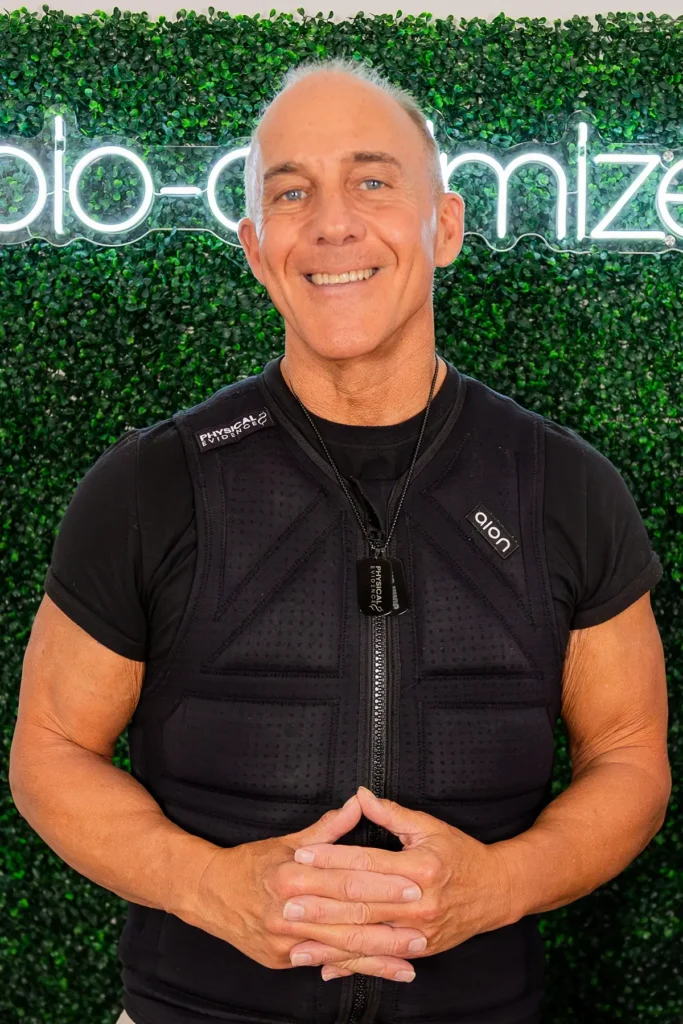
With over four decades of clinical experience in South Florida, Dr. David Lipman combines cutting-edge biohacking modalities (PEMF, Hyperbaric Oxygen, Red Light, Cryotherapy) with evidence-based chiropractic adjustments and soft-tissue therapies.
His philosophy centers on restoring natural biological momentum: removing nervous system interference and supplying the fundamental cellular inputs required for self-healing.
Clear, direct answers regarding clinical efficacy, safety, and device selection.
Most people describe it as unusual for the first few seconds and comfortable after that. The short one-sixteenth-inch stroke means it does not drive into tissue the way percussion does. If something does hurt, say so — pain is information, not a badge.
Rapid Release is registered as an FDA Class I medical device. It’s worth being precise about what that means: Class I is the lowest-risk regulatory category, and devices in it are generally exempt from premarket approval. It’s a classification, not an endorsement of results. I’d rather you hear that from me than discover it later.
Speed and stroke. Rapid Release runs three to five times faster (4,000 to 10,000 VPM) with roughly one-tenth the travel distance (1/16”). A massage gun pushes into muscle; Rapid Release vibrates through it.
For most people, short sessions several times a week are reasonable — and because it stays comfortable, that’s actually realistic. Follow the manufacturer’s guidance, and check with your provider if you’re managing an injury or a diagnosed condition.
Vibration is generally better tolerated on sensitive tissue than percussion, which is why providers reach for it there. That said, scar tissue and post-surgical areas should be assessed by a qualified provider before you go to work on them yourself.
The Traveler ($299) if you want gentle and portable daily maintenance. The ProAm ($599) if you train hard and need four speed settings. The Pro3+ ($999) is built for high-volume clinical practice.
Rapid Release earns its place in my practice for one reason: it lets me work on tissue that wouldn’t tolerate anything harder, and it keeps people relaxed enough to actually release.
It won’t fix your posture, your sleep, or your hydration. Nothing in a carrying case does that. But as one input among several — as a way to remove one obstacle so your body can get on with the work — it’s among the more useful tools I’ve added in four decades of practice.
EXCELLENTTrustindex verifies that the original source of the review is Google. Life-changing experience with Dr. Lipman Dr. Lipman truly saved me today. I’ve been seeing a chiropractor on and off, but it turns out my issue was much deeper than just adjustments. What I was dealing with was significant fascial restriction and twisting that needed to be released, not just cracked and sent on my way. Dr. Lipman immediately recognized this and took the time to actually address the root of the problem. His knowledge of fascia and the body as a whole is incredible. The work he did was intentional, thorough, and exactly what my body needed. Even though I know I have a journey ahead of me, I already feel so much better after just one visit, which honestly says everything. I finally feel hopeful instead of frustrated. If you’ve been going to chiropractors and feel like something is still “off,” do yourself a favor and see Physical Evidence Chiropractic: David Lipman, DC. This is a whole different level of care, and I am beyond grateful I found him. Highly, highly recommend. I want to add I’ve seen him a few years ago and he was amazing but his visits had cost a little more than my regular chiropractor and now my body truly paid the price!!! not once did he make me feel bad for not coming back he picked up right where he left off!!Posted on GoogleTrustindex verifies that the original source of the review is Google. I was given an unlimited month of red light therapy for Christmas! Today I enjoyed my first session and am super happy with the vibe. Dr Lipman is wonderful, and his receptionist Sage certainly takes today's review to the top! I purchased methylene blue and got the list of prices so that when my unlimited month is over I can continue on. Definitely five stars for cleanliness, convenience and easy to find using Google maps. Boca Raton has a GEM in Physical Evidence.Posted on GoogleTrustindex verifies that the original source of the review is Google. I’ve only seen Dr. Lipman once so far, and I’m already blown away. I went to him for a piriformis issue, and unfortunately I had taken a fall right before my appointment and was in quite a bit of pain. Dr. Lipman addressed it immediately and the pain was gone by the time I left his office. What truly amazed me is something I didn’t even mention to him. Years ago, I was in a severe accident and have had limited ability to turn my neck. I had accepted that this was just how it would be. After just one visit with Dr. Lipman, I have full range of motion in my neck, something I haven’t had in years. This isn’t my first experience with chiropractors; I’ve seen many over the years. Dr. Lipman is different. He genuinely takes his time, listens, and truly cares. He is incredibly knowledgeable and clearly has a passion for helping his patients heal. He is so much more than a chiropractor. Highly recommended!Posted on GoogleTrustindex verifies that the original source of the review is Google. Dr Lipman eliminated severe pain i have had in my back shoulders and neck in just a month of working with him. His treatments were incredibly effective and fast. I have spent years in chiropractic offices, physical therapy, and recovering from surgeries, but nothing has come close to the relief and healing I got from Dr Lipman He’s the manPosted on GoogleTrustindex verifies that the original source of the review is Google. I found Physical Evidence online because I’m increasingly interested in combining physical exercise with technology that helps improve overall health. I felt very satisfied with the service. My specific goal was to try red light therapy, and the red light cabin they have is one of the highest-quality devices on the market. (I like to do my own research whenever I go to a place to see what machines they use.) Especially for me, since I’m looking for skin benefits, it’s much better than just a panel that doesn’t cover the whole body. I also tried electromagnetic therapy, which was very relaxing. Dr. Lipman is very professional. I usually ask a lot of questions about the therapies and how they work, and it’s clear that his knowledge is extensive. He also helped me better understand what to do about my lower back pain. Definitely a must-try for people who want to experience modern therapy for wellness and beauty. Dr. Lipman and his staff are exceptional.Posted on GoogleTrustindex verifies that the original source of the review is Google. Amazing doctor and great person. Everyone in the office is wonderful and I always leave feeling better. Highest recommendation.Posted on GoogleTrustindex verifies that the original source of the review is Google. A mix of science and holystic that is giving me results 💪🏽Posted on GoogleTrustindex verifies that the original source of the review is Google. I visited Dr Lipman's office today, received and adjustment and information on the services he offers including the Super Human Protocol. He is an incredible wealth of knowledge and is intentional to explain things in a way that is easy to comprehend. I found him to be very trustworthy and I FEEL GREAT!!!! Thank you Dr Lipman, I look forward to my next visit!Posted on GoogleTrustindex verifies that the original source of the review is Google. I recently had the pleasure of visiting Dr. Lipman for my husband's back pain, and I can't recommend him highly enough. From the moment we walked in, his professionalism and empathetic nature stood out. Dr. Lipman took the time to listen to my husband's concerns and thoroughly assessed his condition before proceeding with treatment. What impressed me most was his caring approach—he made sure my husband felt comfortable and informed every step of the way. The treatment plan he provided was tailored specifically to my husband's needs, and we both appreciated how he explained the process in a way that was easy to understand. Thanks to Dr. Lipman's expertise, my husband has experienced significant relief from his back pain. If you're looking for a chiropractor who combines professionalism with genuine care for his patients, Dr. Lipman is definitely the right choice!Posted on GoogleTrustindex verifies that the original source of the review is Google. Dr. David Lipman is the absolute best in the business. Other doctors will give you temporary relief but Dr David will treat the root of your problem and ensure your relief. I have referred 5 people to him and everyone including myself, has been relieved of the prolonged issues they have had. I suffered from injuries and dealt with chronic issues and pain from them. I never thought I would have complete relief. Dr. David cured me. He is full of knowledge and so kind. I can’t say enough good things about him. Thank you Dr. David.
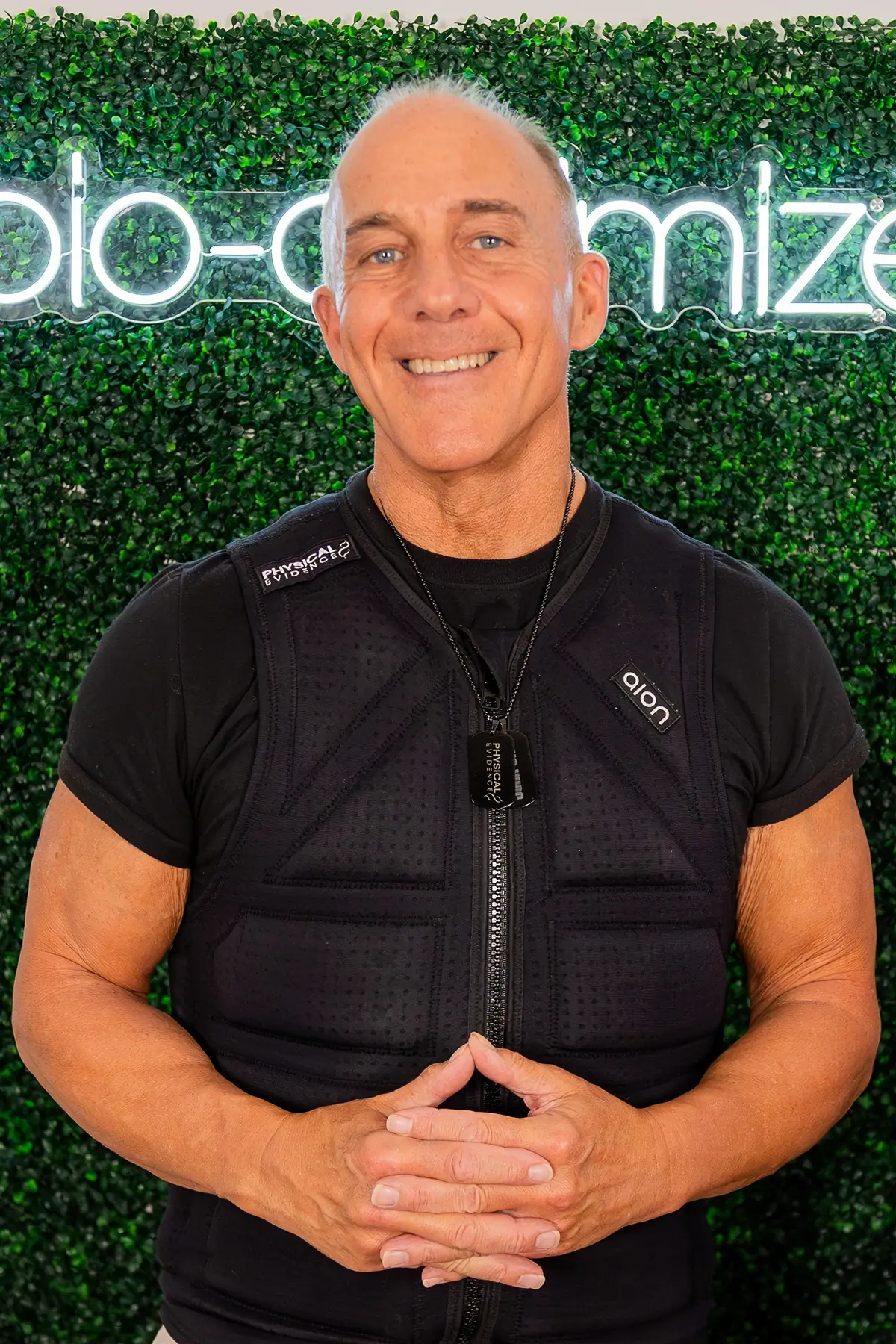
When I was fifteen, I fractured my neck in a motorcycle accident. Surgery was recommended, and I was told I would likely live with restricted motion.
Years later, I faced another setback when a ruptured disc and advancing arthritis led to similar recommendations. Again, surgery was presented as the solution.
I chose a different path.
I began studying how structural alignment, oxygen efficiency, and cellular energy production influence long-term performance. Instead of focusing on isolated symptoms, I focused on how the entire system functions together.
What I discovered is simple: when the body’s energy systems and structural systems operate efficiently, performance improves. Recovery improves. Strength improves. Longevity improves.
In my early sixties, my strength and endurance metrics were those of someone decades younger. That was not luck. It was the result of structured, measurable optimization.
Physical Evidence was built from that experience.
We are not here to offer quick fixes. We are here to help high-performing adults maintain energy, mobility, and independence as they age.
If you are someone who refuses to accept unnecessary decline, you will feel at home here.
Founder, Physical Evidence
Start with a $29 red light therapy session and facility tour experience how a structured biohacking approach can support long-term performance.
See South Florida’s advanced biohacking center. Get a full facility tour + your first Red Light Therapy session.
Includes: Theralight 360 Session + Clinic Tour + Quick Orientation